
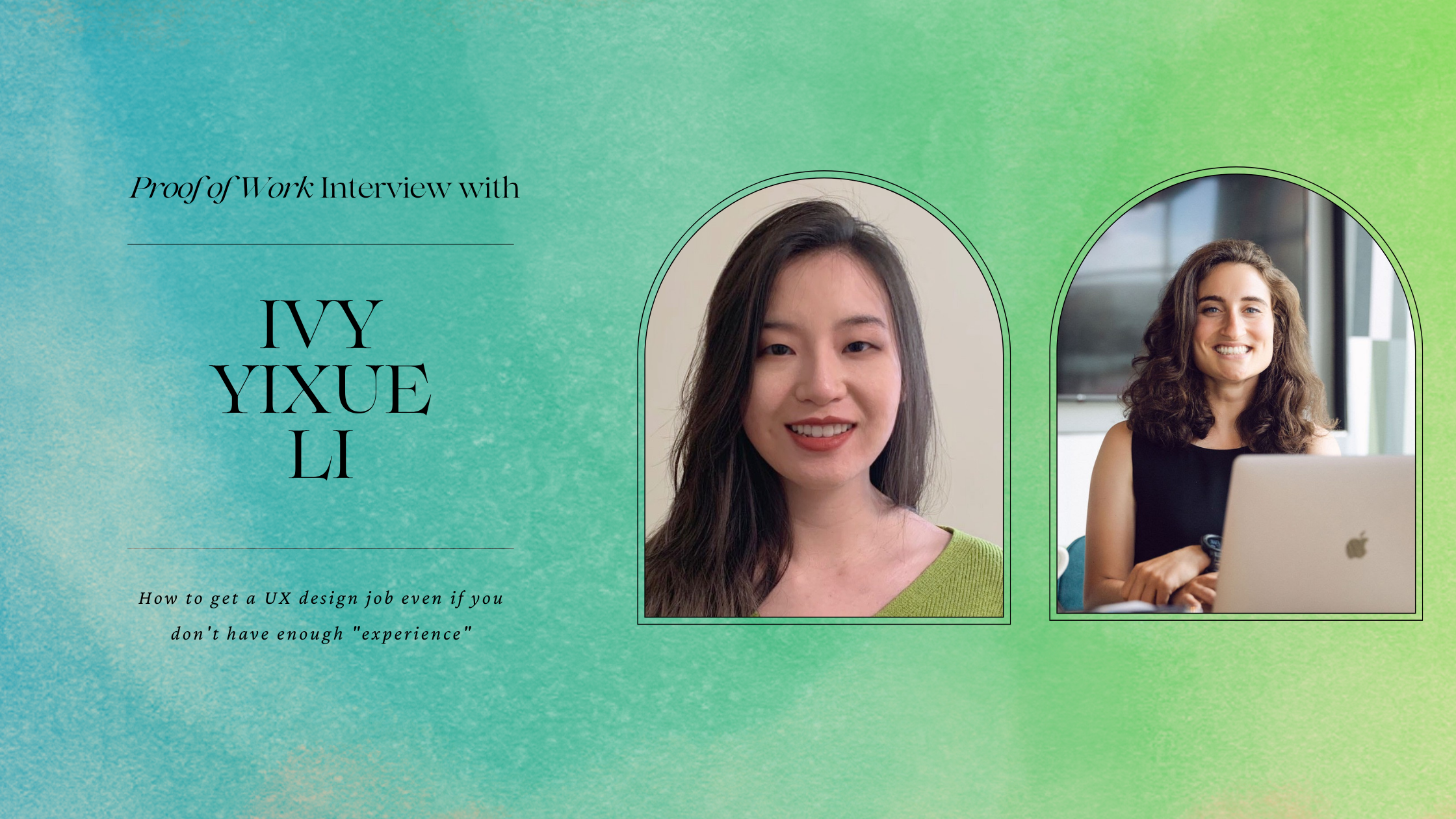
Ivy Li got her first design job through a professor who recommended her to the communications office at her college, starting out by creating classic communications materials in the form of gallery posters and open studio flyers. She was still in her undergrad, but she was always looking for opportunities to continue making real design work. In one instance, she cold-messaged a student theater production at USC on Facebook to ask if she could design their print materials. "Something people don't use now," she said, laughing.
Today Ivy is a visual designer at Google, though her path to get there was not straight. She said that she wanted to go to grad school, because she felt like she needed more graphic design training. She later continued her career with a teaching position at Parsons, years of freelance, and eventually a cold LinkedIn message that opened an unexpected door.
When deciding where to do her MFA, she looked at the student work before anything else. "Students' work from Virginia Commonwealth University was the most fun and most unique," she said. "Everyone had their own perspective. Some other schools, I felt like they all came out doing the same things." She wanted to find a school where designers came out as individuals; the overall rankings themselves mattered less. She found that the experience provided her a new point of view about design. "Design, to me, is more about culture, about your personal experience, your personal values, and speaking those through graphic design."
When I asked what part of her MFA ended up being most useful in practice, I was expecting typography or thesis work, but she said it was the network. Her advisor kept telling the students to stop thinking of themselves as students and start thinking of themselves as colleagues. Speakers who visited got invited to lunch. One of those visiting speakers got interested in her thesis work and offered her a teaching position at Parsons. From there, introductions to New York design studios. Then, it was freelance, and then more work. "This industry is connected," she said. "You know people through people, and people will see your work."
Then, Ivy saw a role at Google on the team she was interested in. She applied, and heard nothing. So she found the creative director on LinkedIn and sent a message: here is my portfolio, would you like to take a look? No response for a month or two. Then she finally heard back: the role you applied for is more UX-focused, but we have two freelance visual designer openings. Would you like to interview? It certainly was a cold message, a long wait, and a door that opened sideways. When she was reflecting on her portfolio at the time, she was candid: "I wouldn't say my portfolio was perfect with today's eyes. But I think the creative director probably liked the enthusiasm and the passion and the fun in my designs."
She has also spent time reviewing portfolios for the Google Creative Fellowship, a program for candidates with nontraditional backgrounds. In those reviews, effort tends to get more attention than polish. One applicant made a video for their application that was not required, using Gemini to write and perform a song about the product, and that person was selected. "Those extra things do make you stand out," Ivy said. "At least you'll get people's attention for a few more seconds on your portfolio." And as she said, a few more seconds is sometimes all you need to be memorable.
I asked what she would do if she were starting from scratch today with no background and no job, and she laid out her strategy in three steps. First, go hands-on: painting, illustration, photography, making physical things. "Those are things that cannot be taken away however the technology evolves." Second, talk to a lot of people. The day-to-day of a design job can look very different from the outside, and you want to know what you are actually signing up for. Third, develop a personal workflow: figure out how hands-on skills, software, and tools like AI can come together into something that is distinctly yours.
When I asked how her definition of success has changed, she laughed before answering. "Five or ten years ago, I probably wanted to be a partner at Pentagram. Someone with a big name. A Wikipedia page." Now she pointed to two recent projects: an event honoring Yellow Pearl, a Chinese-American band from the 1980s, for which she designed the posters, and helping friends running a design residency in Nepal with their visual materials, both completely unpaid projects. "If I do more of those things, I'll gradually have a voice, speaking out for things I care about," she said. "I think that's probably what I would find successful. Hopefully."
She said her advice to her younger self is to trust your instincts and keep going back to why you wanted to do this in the first place, because the journey will give you plenty of reasons to forget.
I really enjoyed my conversation with Ivy, and something I keep thinking about after our time together is how practical her three steps to start today are. Start with your hands. Talk to people. Build something that is yours. There is no waiting for the right moment in any of that. It is just a low-stakes way to start moving, which is usually all you need to begin and carry momentum forwards.