
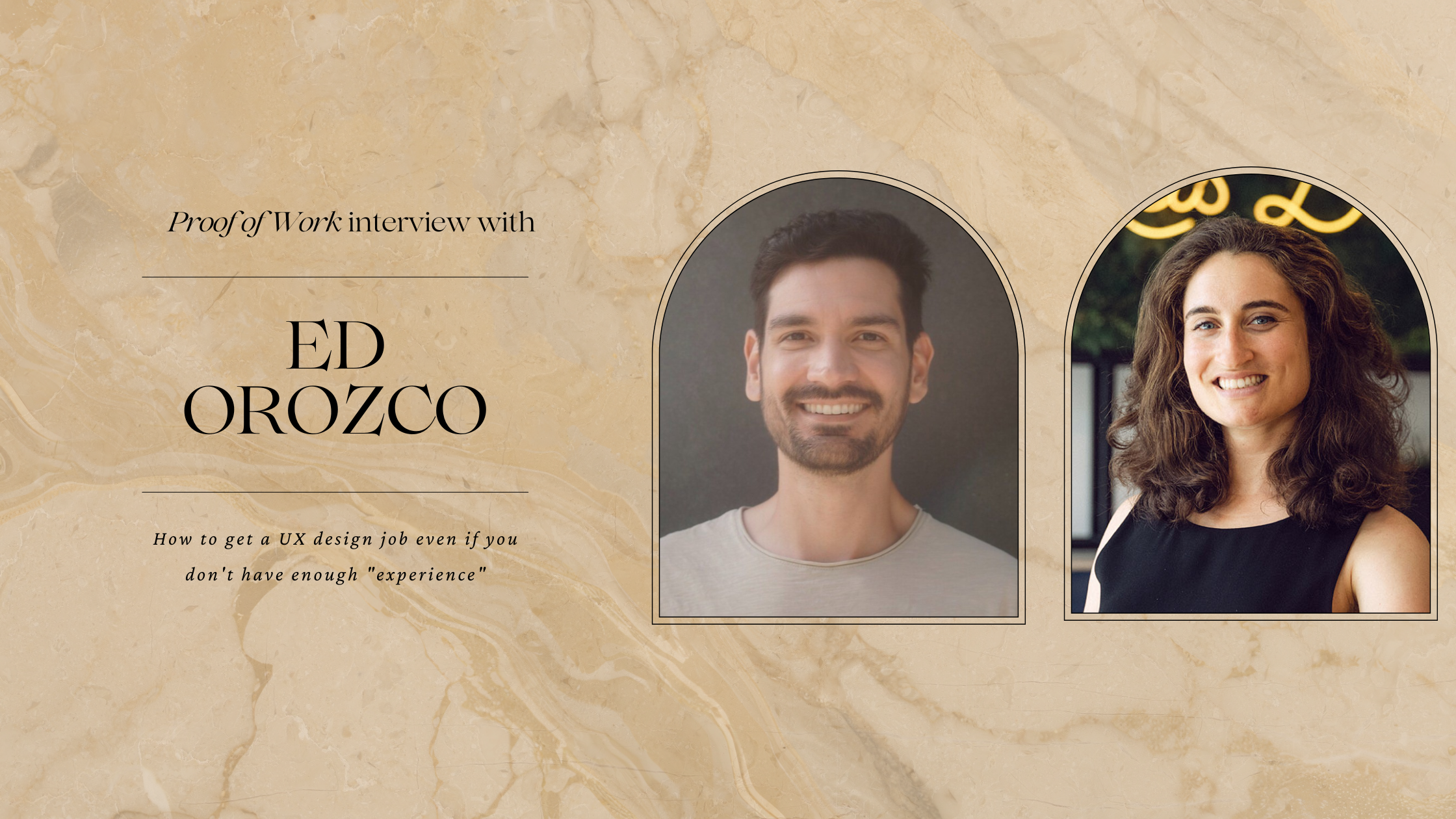
An interview with lead designer and writer, Ed Orozco
I got to sit down with Ed Orozco, Lead Designer at Zoios, who has spent most of his career working in early-stage and growth-stage B2B startups. He’s also a longtime (and fantastic!) writer for UX Collective, where he’s been publishing thoughtful, opinionated pieces on design, technology, and the realities of product work for years.
I wanted to talk to Ed because his experience contrasts with many of the designers I’ve spoken with so far. A lot of those conversations have centered on large organizations, mature teams, and clearly defined roles. Ed’s career has unfolded mostly in startup environments, where structure is lighter, expectations shift quickly, and learning happens while the work is already in motion.
With more designers trying to figure out how to build experience without a clear ladder in front of them, I was curious how someone shaped by that kind of environment thinks about getting started, staying grounded, and continuing to learn when very little is spelled out.
So I asked him how it all began.
Early work before it felt like “design”
Ed’s first real design experience began when he was studying business and volunteering with an NGO in Brazil that supported blind individuals. They needed help redesigning their website, and Ed stepped in.
“There was the director of the NGO, who was blind, and had opinions about what the website should be,” he told me. “Then there was the developer, who had a completely different opinion. And the board was mostly blind too.”
The goal of the site was simple. It needed to raise donations so the organization could keep operating. The process was not. Accessibility requirements were central. Stakeholders had strong opinions. There wasn’t a shared understanding of what design was supposed to do or how decisions would get made.
Most of the work never shipped.
“At the time, I didn’t realize how common that situation is,” Ed said. “Now I see it everywhere.”
The feeling that wouldn’t go away
After that experience, Ed moved toward something more conventional. He took a business internship at a consulting firm working on projects for the European Commission. The work was structured and predictable, mostly between budgets, proposals, and coordination.
“I hated it,” he said, laughing.
He said he felt dissatisfaction during work hours. He realized he had found himself opening Photoshop and Illustrator in the evenings because it helped him decompress, and he wanted to keep designing.
Eventually, he quit. He taught Spanish for a while, then moved to Buenos Aires to pursue a master’s degree in design.
Finding UX before it was everywhere
It was during that program that Ed encountered user experience in a way that felt substantial.
“It was a UX class,” he said. “I didn’t really know what UX was before that.”
This was 2012. iOS was still early. Skeuomorphism dominated interfaces. UX frameworks were only beginning to show up in academic settings. The class connected design, technology, and human behavior in a way that immediately resonated. “I was hooked.”
He shifted his thesis to focus on user experience for wearable devices, writing about Google Glass at a time when it was still experimental and difficult to access. He gathered whatever material he could find: documentation, interviews, basically anything that helped him think through how people might actually interact with technology worn on the body.
Stepping into startup UX
When Ed started looking for UX work, he didn’t have much hands-on experience yet but he did curiosity, theoretical grounding, and a growing sense of how he wanted to think about products.
His first official UX role was at an Argentinian startup working on natural language processing for social media sentiment analysis, long before large language models were part of everyday conversation.
“They didn’t really know what kind of designer they needed,” he said. “They just knew the product was very complex and hard to use.”
One interview stood out. An experienced designer had been brought in to help evaluate candidates. She commented on how unusual the market felt at the time. Demand for UX was growing quickly, but very few people had actually practiced it.
“It was a very different moment,” Ed said.
Writing as a way to think
Because Ed is such a popular contributor at UX collective (and how I found out about him!) I wanted to ask Ed about writing, and specifically when and why he started.
He paused.
“I don’t actually remember why I started writing,” he said.
Before Medium, there were blogs on different platforms. Posts that were sometimes personal, sometimes observational, sometimes unfocused. Over time, the writing shifted.
“I started writing about things I was noticing in products,” he said. “Interactions that felt really good.”
He wrote about early swipe gestures, app switchers, and products like Mailbox and Inbox by Google. Not to position himself as an expert. More as a way to understand what was working and why.
When he found Medium, it felt like a better place for that kind of thinking. He moved his posts over and kept going, and really found a rhythm with it and is still posting regularly.
Building small things, on purpose
I asked Ed whether he’d ever intentionally created his own experience outside of work.
He thought about it for a moment, then said, “I think I always had side projects. Sometimes too many.”
More recently, during paternity leave, he returned to building small things out of curiosity. Using tools like Cursor and early AI assistants, he experimented without much pressure.
He built a project for his wife that pulls live weather data and recommends clothing based on the forecast. “What Should Julie Wear?” is simple, practical, fun, and still something his family uses.
“I built it mostly for fun,” he said. “And to learn.”
AI, fundamentals, and what still matters
We talked about AI, coding tools, and how accessible building has become. Ed is optimistic about what’s possible, but careful about where people place their energy.
“AI is not paying you money,” he said. “It doesn’t have the same incentives as real customers.”
What he keeps coming back to are fundamentals that don’t disappear when tools change. Talking to real people. Learning how to interview. Understanding systems well enough to scope work realistically and have grounded conversations with engineers.
“You don’t need to be an engineer,” he said. “But you do need to understand the technology you’re designing for.”
As the conversation wound down, Ed’s career felt less like a sequence of strategic moves and more like a pattern that repeated quietly over time. Volunteering early. Writing openly. Building small things out of curiosity.
As the conversation wound down, I realized again a pattern that was resurfacing. Ed didn’t wait for the work to feel official before taking it seriously. He volunteered before he had a title. He wrote before he had an audience. He built small things before anyone asked him to.
None of it was framed as “creating opportunities” at the time. He was just curious. That throughline matters, especially now, when many designers are waiting for the right role, the right opening, or the right permission to start. Ed’s path is a reminder that experience doesn’t always come from the places we expect it to. Sometimes it comes from staying close to the work, even when it feels informal, unfinished, or invisible.
That idea sits at the center of my book, the importance of not chasing credentials or titles, but learning how to make the work real before someone else defines it for you.
Ed has been doing that all along.