
Build the plane mid-flight: a conversation with John Maitland, Director of Design at Rocket Money
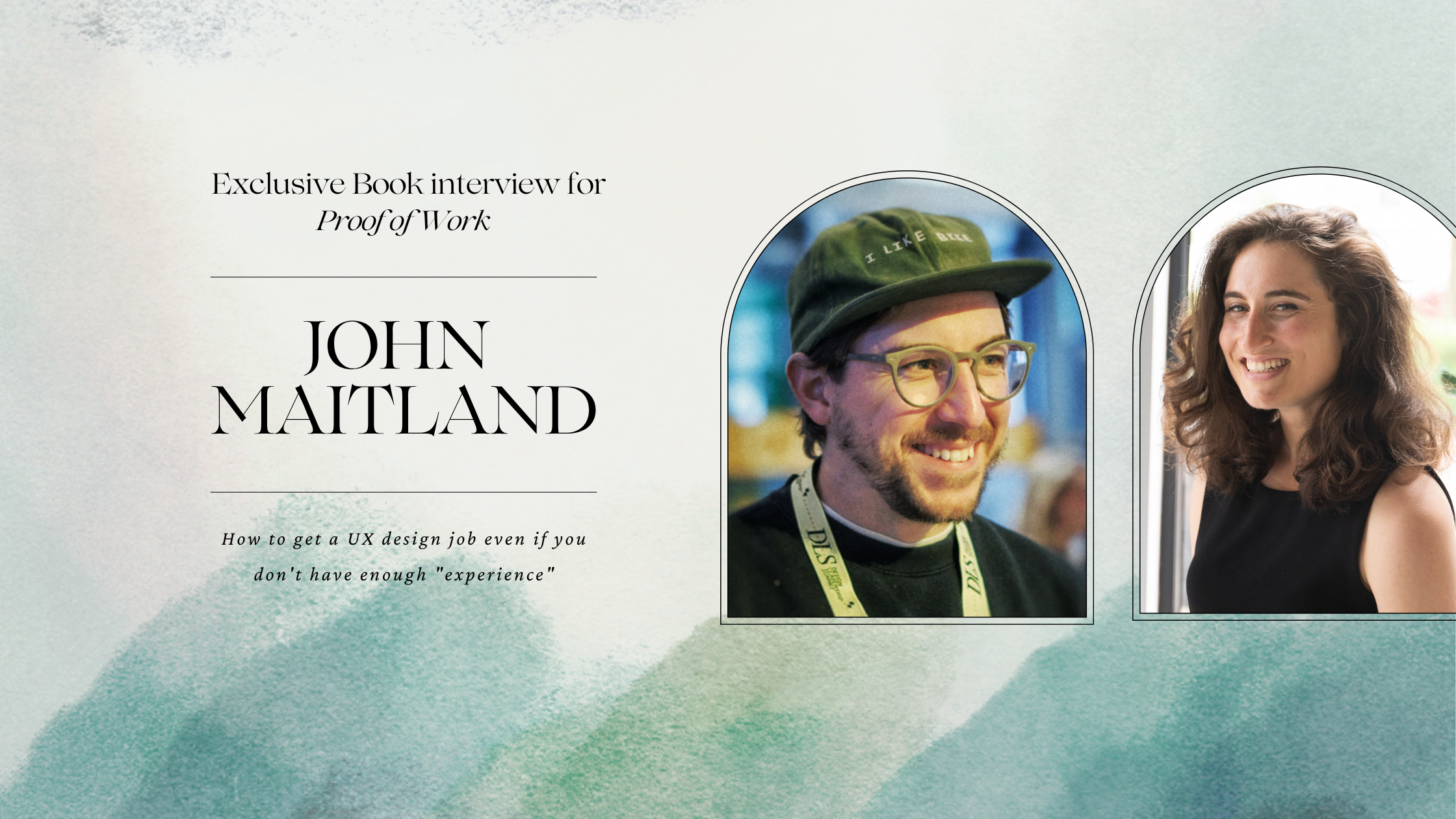
At first when I started doing these interviews with designers and working on my book in tandem, I felt like maybe I just needed to talk about the skills necessary to become a UX designer, or even just teaching the mindset to get into UX. However, as I kept writing, I began to get more and more stuck in certain parts of the advice I was giving.
From the people and students I’ve talked to, most junior designers are doing everything they were told to do and still hitting a wall, and I wanted to understand why they might still not be getting hired, and that maybe there was a need to investigate the gap between what design education promises and what the industry needs right now.
I realized that what I was missing was a view from the other side of the table: what hiring/design leaders are actually seeing when they review junior candidates, what's changed about how design teams get staffed in the last two years, and how the industry has changed fundamentally.
So I messaged John Maitland, Director of Design at Rocket Money, who has significant experience hiring UX Designers to get his thoughts.
John had always been a tinkerer, and a maker; his Dad was an auto mechanic so he grew up around a culture constantly building and taking things apart.
John didn’t really feel like college prepared him for how the world really worked, as he said, “I knew in college that VCU wasn't preparing me the mainstream design landscape. It's art school, a fine art degree, and something about that wasn't adding up to the technological world we were being born into. I hadn't figured out how to marry those things by the time I graduated.”
He landed an internship at an architecture studio in Richmond during college, doing marketing work, and found his first real mentor in Christie Thompson. After graduating he took a job at an architecture studio as an exhibit designer, burned out, and biked across the country with no plan. When he got back, he cold-emailed Christie referencing the internship from years prior, and she was hiring a contractor. "I boondoggled that into four years of full-time work." He paused. "I vowed in college I would never do branding. And here I was, doing branding. Don't hold your opinions too tight."
I wanted to dive into the hiring aspects of his role, and asked him about hiring in general. "The junior role has kind of collapsed," he said. "I've hired seniors and leads, and honestly I'd step those titles down from where they are. There's a huge inflation in titles right now." He said juniors should just apply to the senior role.
So I asked him what actually makes someone stand out when he is reviewing candidates, expecting him to talk about portfolios.
"What I'm looking at early is personality. Being interested and engaged and talking about things in a human way, whether it's related to the role or not. That interestedness, hunger, engagement, it shows a readiness to work. I can teach design tools. I cannot teach you how to give and receive feedback without crumbling. Those things take too long."
“So what gets people passed over in your rounds?” I said.
“Craft. A lack of it. But not just in the work itself.” John said he checks whether a resume uses the same type system as the applicant’s website. Whether the portfolio renders well on mobile. Whether the email address comes from a custom domain. "My email isn't @gmail.com, it's @my website. It's like seventeen dollars a month. You stand out at the top of the resume pile and it shows attention to detail that isn't even visual. You're thinking about design for yourself, not just for the work you hand in."
Something some of the students I had talked to were curious about developing craft without a strong mentor or rigorous program, and I was sure to ask him directly. He said, "It takes making mistakes. Make an expensive mistake. The design masters you're taught about are edited. In the documentaries, in the books, they look like they never mess up. But they spend more time reviewing their work than making it. So when you think you've double-checked, double-check again."
He told me about a print job he did recently at FedEx Kinkos. He thought he was selecting a finish. He got full lamination. It was a menu, so it worked out. But he still kicked himself. "Even now it gets you."
So what’s John’s advice for the first 90 days of a new role?
“Say yes to everything. Figure it out. Ask questions. Write down words you don't understand. Build the plane mid-flight. You have to be okay with all of that discomfort."
He also had a take on imposter syndrome I wasn't expecting. "I'm over it… Your paycheck is your validation. When your boss corrects you, that's not proof you're bad at design. Good designers make mistakes. Roll with it."
His first hire years ago, in his words, was bad. He was not ready to manage and the person he hired was not ready for the role. "[It was] the blind leading the blind. The worst part was knowing it was my fault." But, it taught him to cut the hiring process down and have hard conversations early.
He also cut the number of interviews from around six to four. "Long interview processes used to signal prestige. Now they just take up everyone's time and they're easy to game with AI anyway. I want to get to know you as a person, see your work, see how you work in a live exercise, and see how you do in front of leadership."
For his most recent hire, he is the last check, not the first filter. His design team screens portfolios. The people who will actually work with this person help choose them. "If I make every call, I keep hiring the same type of designer. A team built in one person's image is a fragile team."
We talked a little bit more about the general state of the UX industry, and he said what a lot of other designers I’ve talked to have said as well: jobs were easy to find when he graduated in 2016. Then 2022 happened. "Most of these companies are venture-backed, and that money is tied to global markets, which are tied to global events. Pandemic, inflation, war. It all flows down to the individual contributor. That's just how it works." Design systems raised the floor and accessibility improved, but everything started to look the same. "Every app has been Airbnb-ified. Navigation used to be weird and unconventional. Now it's beige and functional and consistent."
When I mentioned I was in a founding design role where the company had been building with AI prototypes before I arrived, that I'm in VS Code more than Figma right now, he nodded. "Craft and speed just aren't really compatible right now. I would rather just work with you in VS Code side by side. Why introduce a middleman?"
I asked him what he wished he could tell every new designer.
"My story, when I look back on it, is all about who I knew. Those people gave me the confidence and reassurance that I was doing the right thing. Whether it was my grandparents buying me sketchbooks or Christie taking a chance on me and then doing it again. Build your little Pokedex."
He walked up cold after a VCU talk and asked a designer he admired if he wanted an intern. To his amazement, the designer said yes, but John couldn’t afford to move to Zurich for an unpaid position. But he had asked. "I threw myself at this thing. I was embarrassed. But I did it."
He is planning to open junior roles at Rocket Money next year. He will have to defend it to leadership, but he’s doing it anyways. "Someone's got to make room. I interviewed for my role here and the CEO said, don't you think you're a little young for this? And I said: I assure you I will get the job done. I was 27. I'd been out of college five years. But I said it, and I meant it."
If there’s anything I’ve learned from writing this book, it’s that social skills and craft are both foundational, yet both hard to teach. You build one in crits, in conversations you push yourself into before you feel ready, and the other in late nights on the clock, bad print jobs, and expensive mistakes. John said he’s planning to open junior roles at Rocket Money next year, and he’ll have to defend it to leadership, but he’s doing it anyways. Because someone has to make room, and the designers who show up curious, connected, and willing to be wrong are the ones worth making it for.